Ultra-Low Noise Crystal Multiplied Unit

by Daniel Lowbridge, Garry Thorp, Toby Brown - Linwave Tehnology
Linwave Technology has a world renowned status for supplying cutting-edge RF & mmWave sub-systems to customers all over the world. By incorporating expertise in a wide range of disciplines we are able to provide custom solutions to a vast variety of applications. The latest avenue of R & D from Linwave was to explore ultra-low phase noise oscillators and clock units.
Market and customer requirements showed a clear demand for low phase noise references to be used within an array of applications. Therefore an internally funded project was launched to push Linwave towards cutting edge performance. From this, Linwave is pleased to announce their latest range of world class multiplied crystal oscillator modules- the XMU series.
Featuring in excess of 50 years of oscillator and RF design expertise, the XMU series shows the ultimate combination of skills and knowledge to allow for the series to offer both an off-the-shelf and custom solutions with unparalleled phase performance. The XMU series can be customised to offer any fixed frequency solution between 200MHz and 12GHz, with further customisation options available.
1 Phase Noise Introduction

As commonly denoted within literature, phase noise is derived from random changes within the phase and frequency of an otherwise fixed frequency. The data represented within figure 1 highlights in base form of phase noise, and the concept of spectral deterioration from the ideal state of an impulse within the frequency domain. In an ideal signal source, a perfectly clean sinusoidal waveform would be generated at the desired frequency- often referred to mathematically as fo- which would results in a clean impulse signal on a spectrum analyser. However, in practicality there are several contributing factors that degrade this signal in the time domain- known as jitter- and hence degrade the spectral performance. As a unit of measure to quantise the level of noise on the signal, phase noise measurements are taken. These measurements typically look at a ’single side band’ (SSB) of the spectrum, with the fundamental serving as the reference to the offset. This results in a noise profile as shown in figure 4. Typically, phase performance is dictated by various forms of noise given the bandwidth away from the carrier.

As shown in figure 2, the frequency information contained within the phase noise plot can be useful for investigating contributors, and diagnosing issues. For a typical crystal based application such as the XMU, close-to-carrier phase noise at offsets below 10Hz, is typically dictated by the inherent performance of the crystals within the unit, providing there is no other source deteriorating past this level. The XMUemploys ultra-low noise techniques to ensure that the crystal amplifier adds a negligible amount of additive noise, and any maintaining or connecting circuit will not degrade the close in noise performance.
A further circuit consideration in noise performance is the noise floor of the system. Typically the noise floor is heavily dictated by the amplifier stages within a VCO or oscillator circuit. Amplifier’s by nature amplify everything over its given bandwidth, as well as adding intrinsic noise from the device itself. It is therefore key to evaluate the compromise between establishing good SNR performance without degrading the floor.
The XMU features ultra-low additive noise bipolar-junction transistors to provide a substantial gain without impacting the phase floor. In order to measure and validate this performance, Linwave has access to some of the latest test equipment enabling RF phase noise measurements to the theoretical thermal noise floor. This ensures there is sufficiently verified and accurate test data for each unit.
2 XMUDesign & Background
The XMU series features a multiplied crystal design, with enhanced vibration sensitivity when compared to standard crystal designs. This is thanks to a unique approach giving improved X and Y axis cancellation. Based off theoretical approximations for the provided crystal performance, the XMU series can offer a typical acceleration sensitivity ≥ 7.9 × 10⁻¹¹/g. Figure 3a demonstrates the block configuration of the fundamental crystal, with figure 3b showing the cascaded multiplier amplifier design that allows for complete customer-driven design.
As can be seen, the base module is focused on a multi-crystal OXCO base from one of the leaders of crystals, Croven Crystals. By starting with the gold standard in phase noise performance, and with careful consideration given to the unique multiplication methods, Linwave is able to provide multiplication of the frequency with degradation close to the theoretical limit as depicted by formula (1) below.
D=20×Log(N),
where D represents the noise floor degradation, and N is the frequency multiplication factor.

By featuring a multi-Crystal approach with hermetic sealing, the clock unit can be successfully configured to provide any integer multiple of the base crystal frequency. Within both circuit blocks, the amplifier stages and BPF filter combinations ensure that the small signal signal-to-noise ratio (SNR) is maintained before the final stage power amplification. In order to match market requirements, the XMU series boasts an output power of typically +16dBm. Not only does the XMU provide a large output power, each unit has two in-phase output ports for various applications.
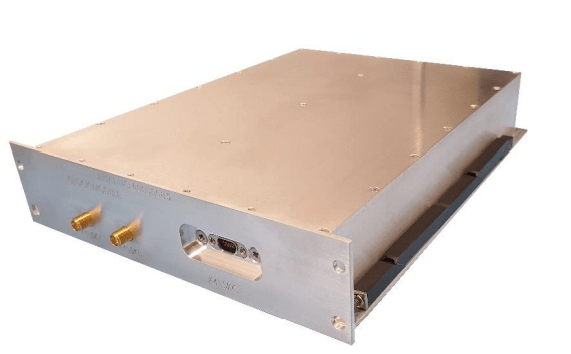
Potential alterations to the product may be to include a balun to allow for 180° differential clock signalling, and Linwave have identified this can be done utilising a vast selection of off-the-shelf components. There is also the option to have this feature internal to the unit, with a customised profile varying from the standard 212mm x 156mm x 36mm housing.
3 Phase Noise Performance
Given the markets demand for increased RADAR accuracy and resolution, as well as the recent increase in Quantum technology- there is a big drive for phase performance within a system. Especially for system reference clocks. We are therefore pleased to reveal that the industry leading Linwave XMU phase noise data can be seen in table 1.

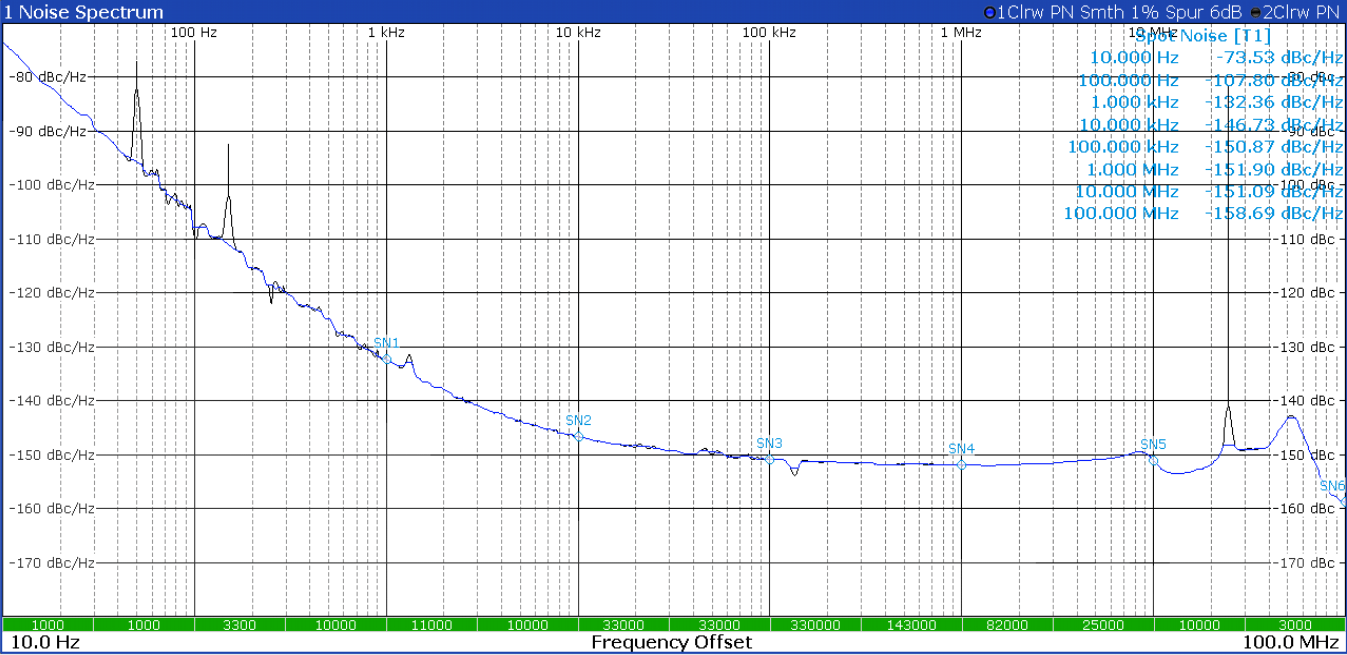
The data presented in table 1 highlights the outstanding performance that the latest XMU series can achieve. Using unique and discrete multiplier techniques, the clarity of phase noise from the original crystal is maintained as best as possible, resulting in data second to none. Given the order of magnitude seen in the results, it is important to ensure the supply is as clean as feasible. For this reason, the device features a ±12V supply with internal regulators to ensure the crystal circuity sees a very clean signal with in excess of 76dB of PSRR at 1MHz. Figure 4 highlights the performance from such design practices on a 5.6GHz center frequency.

Figure 4 demonstrates the phase noise performance that can be achieved at 5.6GHz from the XMU free running unit. It surpasses −73.5dBc/Hz at 10Hz, with a floor at −153dBc/Hz. Comparison to a typical market competitor for a similar application and use case suggests that the XMU surpasses their performance by 5.5dBat10Hz and 10dB on the floor.
Commonly available crystal based multiplied clocks commonly boast output powers ranging from +10dBm to +13dBm, so offering two synchronous outputs at +16dBm allows for customisation without dampening any SNR further down the clock chain. This is achievable through the latest releases of commercially available GaAs HBT amplifiers which are able to provide remarkably low additive noise, being combined with passive integer multipliers. This enables the flexibility within the XMU to alter the power output to almost any customer requirement.
References
[1] SYNERGY Microwave Corporation. Noise Minimization Techniques for RF and MW Signal Sources. https://synergymwave.com/articles/2007/09/, 2007. [Online; accessed 25-Oct-2023].
[2] Jacob Trevithick. How do amplifiers affect signal phase noise? https://markimicrowave.com/technical-resources/tech-notes/how-do-amplifiers-affect-signal-phase-noise/ , 2020. [Online; accessed 25-Oct-2023].

your
local specialist
for