Assessing Remaining Battery Life
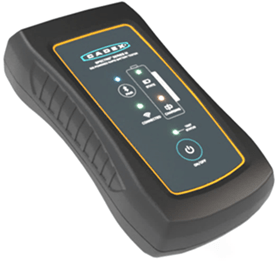
Spectro Modular estimates the remaining useful life (RUL) of a starter battery by assessing capacity and CCA. Capacity embodies electrical storage and CCA represents cranking ability.
why do starter batteries commonly fail?
Capacity fade is the most common cause of failure that often goes unnoticed. An engine may still crank well at 30%; however, going lower in capacity is subject to no-start, especially on low charge and when cold.
A CCA test alone does not provide conclusive results, nor can BMS predict capacity of a starter battery.
Starter batteries have two common end-of-life scenarios:
- Capacity fade
Gradual loss of energy storage goes unnoticed until the engine stops cranking. Auxiliary loads in modern cars hasten capacity fade. - Heat failure
Corrosion raises the internal resistance that slows cranking. Sulfation caused by partial charge also increases resistance.
End of battery life in most cases is defined by capacity fade. A capacity check identifies batteries in the fringe area marked in amber in the image below. The Spectro CA-12 assesses capacity by electrochemical impedance spectroscopy (EIS).
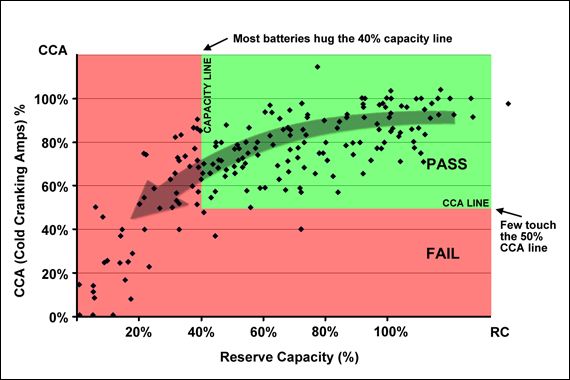
Spectro predicts the remaining useful life of a battery with capacity measurement. A "pass" gives a grace period; "fail" requests replacement
How Batteries Age
A German luxury car makertested the capacity and CCA of 175 starter batteries, shown as stars on the left. The test confirms that capacity is the leading health indicator.A CCA measurement alone does not provide reliable data.
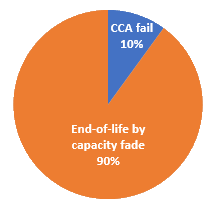
End-of-life starter batteries
Battery Definition
- Capacity
Storage of electrical energy in RC (Reserve capacity) or Ah, capacity loss is shown as a rock buildup. - CCA
Responsible for engine cranking,
illustrated by free-flowing tap. - SoC
Liquid level denotes state-of-charge.
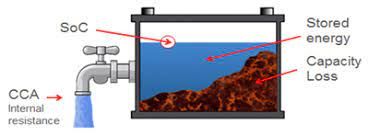
Graphic illustration of capacity and CCA
Core Features Spectro Modular
- Fast - process more batteries quickly
- Easy to use - simple guided test procedure via app
- Reduce Charge & Test - test down to 50% SoC
- Catches low RC batteries - prevent stranded customers
- OPEN API - for seamless integration with: OEM Warranty, Aftermarket, Automotive diagnostic Scan Tools & Telematic systems
- Easy Wireless Connection - with Android phone, tablet or computer
- Scalable for voltage and chemistries (e.g. Lithium and up to 48V)
CM-12: Services regular starter batteries, 12V; 35-120 Ah with generic matrix
CM-24: Services heavy duty starter batteries, 12-48V; 35-300 Ah with X-Matrix
Services lead acid and Li-ion architecture
Additional Features
- Rapid Capacity Tester
- Non-invasive. Unit stays cool during test
- Test time is 30 seconds. Longer with large batteries
- Tests battery down to 50% state-of-charge
- Easy wireless connection with Android phone and PC
- Matrices for deep-cycle and lithium batteries on request
- Communication to host and cloud
- Compact size and ease of use

your
local specialist
for